
The Social Security Administration announced on October 14, 2026, that benefits will increase 3.6% in 2027. Nearly 72 million people who get Social Security will see the raise starting in January, and about 7.3 million people who receive Supplemental Security Income (SSI) will see higher payments starting December 31, 2026. Here’s what the 2027 cost-of-living adjustment (COLA) means for you, and how much Medicare will take before the money reaches your bank account.
Key takeaways
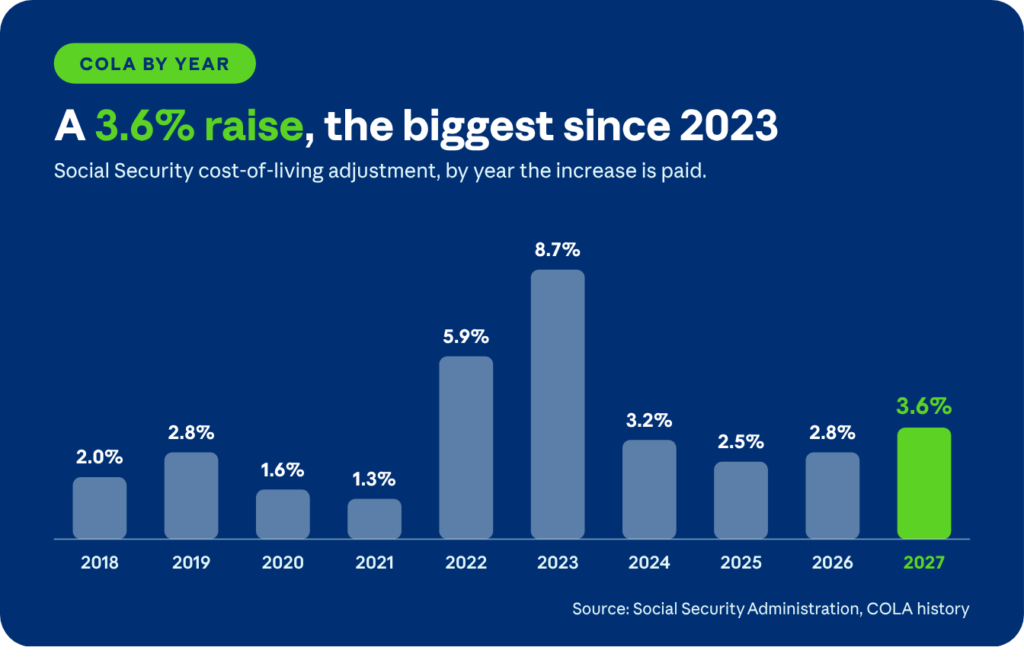
- Social Security benefits will rise 3.6% in 2027, the largest increase since 2023.
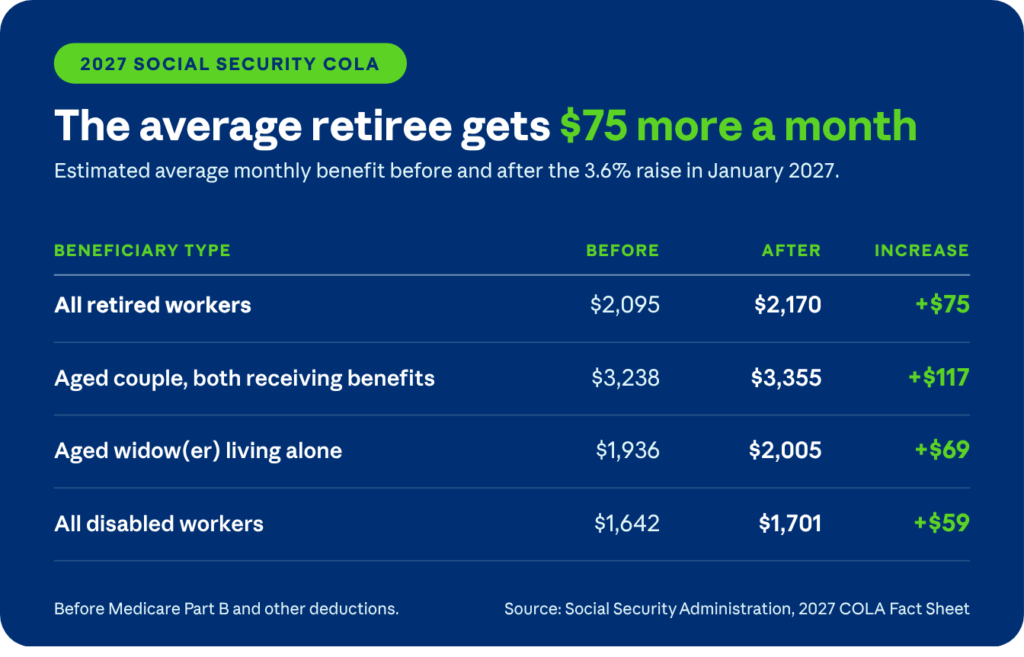
- The average retiree’s check goes from about $2,095 to $2,170 a month, a $75 raise.
- The Medicare Part B premium is projected to rise about $6.60 a month, leaving most retirees with a net raise of roughly $68.
- Your personal COLA notice arrives online in late November or by mail in December.
- Medicare open enrollment runs October 15 to December 7, which is a good time to make sure your raise isn’t taken up by plan costs.
Social Security increases for seniors in 2027
On average, retirement benefits will rise about $75 a month. To estimate your own raise, multiply your current monthly benefit (before deductions) by 1.036. For example, a $1,800 benefit would become about $1,865. The table below shows how the SSA estimates average checks will change in January 2027.
Why the 2027 increase is larger than last year’s
The COLA is based on inflation. Each year, the SSA compares how much prices rose from July to September with the same months of the previous year. It uses that percentage change for the next year’s COLA. The 2027 increase is the biggest in four years.
How Medicare Part B affects your Social Security check
If you’re 65 or older and enrolled in Medicare, your Part B premium is probably deducted straight from your Social Security check. The standard Part B premium is also projected to rise in 2027, which would take up part of your Social Security increase. Medicare’s trustees estimate it will increase from $202.90 to $209.50 a month, an additional $6.60. If you receive the average Social Security retirement benefit and pay the standard Part B premium, your $75 monthly increase would leave about $68 more after the higher premium is deducted.
If those projections hold, it would be the first time since 2023 that the COLA grows by a larger percentage than the Part B premium, so more of your raise stays in your pocket.
Keep in mind that the $209.50 figure is a projection. The Centers for Medicare & Medicaid Services (CMS) will announce the official 2027 Part B premium in November. Higher-income beneficiaries may also pay an extra income-related monthly adjustment amount (IRMAA) on top of the standard premium.
How the Medicare hold harmless rule protects your Social Security payment
A federal rule called “hold harmless” protects most people from receiving a smaller Social Security payment than they did the year before because of a Medicare Part B premium increase. If your premium goes up by more than your Social Security benefit does, the rule limits your premium increase so your Social Security payment doesn’t go down.
This rule mainly protects people with lower benefits because their smaller benefit checks are more likely to face a Part B premium increase that exceeds their COLA increase. Not everyone is covered by this protection. You may pay the full premium increase if you:
- Are new to Medicare or Social Security.
- Pay a higher Medicare premium because of your income (IRMAA).
- Don’t have your Part B premium deducted from your Social Security check.
What the COLA means for Supplemental Security Income (SSI) recipients
Supplemental Security Income (SSI) payments will also rise by 3.6% due to the COLA. In 2027, the maximum federal SSI payment will be:
- $1,029 a month, up from $994, for individuals.
- $1,544 a month, up from $1,491, for couples.
The first payment with the increase will show up on December 31, 2026. SSI limits on how much you can have in countable assets, such as cash and bank accounts, will stay the same at $2,000 for individuals and $3,000 for couples.
2027 earnings limits for employed seniors
If you collect Social Security before full retirement age and are still working, the SSA may withhold some benefits if you earn above certain limits. For 2027:
- If you won’t reach full retirement age in 2027, you can earn up to $25,560 (about $2,130 a month) with no effect on your benefits. Social Security withholds $1 in benefits for every $2 you earn above that limit. For example, if you earn $29,560, which is $4,000 over the limit, $2,000 in benefits would be withheld.
- If you reach full retirement age in 2027, the limit is $67,920. Only the money you earn before the month you reach full retirement age counts. Social Security withholds $1 in benefits for every $3 you earn above that limit.
- Once you reach full retirement age, there’s no limit. You can earn as much as you want without any reduction.
Once you reach full retirement age, Social Security recalculates your monthly benefit to give you credit for months in which benefits were partially withheld because of your earnings.
When will I see my new benefit amount?
Social Security will send you a COLA notice showing your new monthly benefit and any deductions. Here’s when to expect your notice and increased payments:
- Late November 2026: If you have a My Social Security account and are signed up for paperless notices, your COLA notice will appear in your online Message Center. To see it online, you need to create a My Social Security account and enroll in paperless notices by November 18.
- December 2026: If you haven’t signed up for paperless notices, paper notices will arrive by mail. This year’s notice is a simplified one-page letter showing your new benefit and any deductions.
- December 31, 2026: SSI recipients will receive their first payment with the increase.
- January 2027: Social Security recipients will receive their first payments with the increase.
What to do now
- Review your Medicare coverage during open enrollment (October 15 to December 7). Premiums, drug coverage, and networks can change every year. The maximum Part D deductible will rise by $85 to $700 in 2027, but some plans charge less or have no deductible. Comparing plans can help you find lower costs and coverage that meets your needs. It’s also a good time to review your Medicare Advantage plan. If you have Medicare Advantage, check out the top ten changes you might find in your plan.
- Set up a My Social Security account at ssa.gov/myaccount and sign up for paperless notices by November 18 to see your COLA notice online.
- Use your updated monthly payment to plan your budget. Your COLA notice will show your benefit after Medicare premiums and other deductions. If you or a parent needs help at home, consider those costs as well. Our guide explains how families pay for home care.
- Watch for scams. Fraudsters often pose as Social Security or Medicare around COLA season. The SSA won’t call, text, or email to ask for payment or threaten to cut off your benefits.
- See if you qualify for extra help. Medicare Savings Programs and Part D Extra Help can help cover premiums and other expenses. This guide to government aid for seniors explains other programs that can help.
- Plan ahead for senior care costs. Medicare doesn’t pay for assisted living or other long-term senior care costs. If care is needed before a home sells or other funds come through, a bridge loan for senior care can help cover the gap.
Frequently asked questions
1. When does the 2027 Social Security COLA take effect?
The 3.6% increase applies to Social Security payments starting in January 2027. SSI recipients see it in the payment issued December 31, 2026.
2. Will Medicare take part of my 2027 increase?
For most people enrolled in Medicare Part B, yes. Since the Part B premium is projected to go up, some of your Social Security increase will go toward paying it. The premium is deducted from Social Security checks and is projected to rise by about $6.60 a month in 2027. The official amount will be announced in November.
3. Is the 2027 COLA bigger than the 2026 COLA?
Yes. The 2026 COLA was 2.8%. At 3.6%, the 2027 increase is the largest since 2023.
4. Do I need to do anything to get the COLA?
No. The increase is automatic. You’ll receive a notice showing your new benefit amount.
5. How can I see my COLA notice sooner?
Create a My Social Security account and sign up for paperless notices by November 18, 2026. Your notice will be available online in late November.