
Best TV Headphones for Hearing Loss in 2026

An in-depth guide to clearer dialogue, quieter living rooms, and happier families
Introduction: Why TV Headphones Matter So Much for Hearing Loss
If you—or a parent or partner—keep turning the TV up while everyone else is wincing, you’re not alone. Age-related hearing loss (presbycusis) often makes speech harder to follow, especially when dialogue competes with music, sound effects, and room noise. Modern flat-screen TVs don’t help much either: their tiny, rear-firing speakers and cinematic mixes tend to bury voices under everything else.
For many families, dedicated TV headphones are the cleanest solution. Rather than blasting the entire room, they send clear, amplified sound directly to the listener—often with extra tools like speech-boost profiles, left/right balance control, and personal volume settings. That means the person with hearing loss can finally relax and follow the story, while everyone else enjoys a normal volume or even silence.
In this guide, we focus on TV-specific headphones and listening systems that are especially friendly to older adults and people with hearing loss. We’ve drawn heavily from expert reviews, dedicated hearing-aid resources, lab testing, and real-world user feedback to highlight models that stand out for clarity, comfort, ease of use, and reliability.
You’ll find premium RF (radio-frequency) systems with powerful amplification, more affordable wireless kits, a lightweight under-chin TV listener, and a flexible Bluetooth transmitter for those who already own headphones or wear Bluetooth hearing aids. We’ll start with our top picks, then dive into detailed reviews and a buying guide that explains RF vs. Bluetooth, what “low latency” actually means, and how to match headphones to your TV and hearing needs.
Editor’s Note: This roundup has been updated for 2026 with new advice on hearing-health red flags, plus an added pick specifically for lightweight, senior-friendly TV listening.
Our Team’s TV Headphone Picks
Best Overall TV Headphones for Hearing Loss: Sennheiser RS 195 RF Wireless Headphone System
Best for Immersive Movies & TV: Sennheiser RS 175 RF Wireless Headphone System
Best Budget RF TV Headphones: Insignia NS-HAWHP2 Wireless Home Theater Headphones
Best Lightweight TV Listening System for Seniors: Sennheiser Set 860 Digital TV Listening System
Best for Families & Group Watching: Avantree Quartet Wireless Headphone System
Best “Use Your Own Headphones” Setup: Avantree Oasis Plus 2 Bluetooth Transmitter

Best TV Headphones for Hearing Loss in 2026: In-Depth Reviews
Sennheiser RS 195 RF Wireless Headphone System for TV Listening ($399.99) – Best Overall for Hearing Loss

Specs
- Type: RF (radio-frequency) wireless over-ear TV headphone system
- Battery life: Up to 18 hours of use per charge
- Key features: Customizable listening modes, left/right balance control, RF wireless base that connects to TV, over-ear closed-back design
What we like
- High-quality sound optimized for TV and speech
- Customizable listening experience with multiple sound profiles
- Up to 18 hours of battery life for long viewing sessions
- RF connection avoids Bluetooth lag and pairing hassles
- Left/right balance control to compensate for asymmetric hearing loss
What we don’t
- Pricey compared with simpler RF systems
- Bulky for very small or sensitive heads
- Overkill if hearing loss is only mild
Performance and comfort
The Sennheiser RS 195 is one of the few TV headphone systems that feels purpose-built for hearing loss rather than just entertainment. The RF base connects directly to your TV and beams audio wirelessly to the headphones, avoiding the lip-sync issues that can plague Bluetooth-only setups. In testing and expert reviews, the RS 195 consistently stands out for its ability to clarify dialogue without turning everything else into a harsh, fatiguing wall of sound.
Unlike standard headphones, the RS 195 includes specialized listening modes and left/right balance adjustment. That means you can tweak the profile to emphasize speech frequencies and even compensate if one ear is weaker than the other—an extremely common pattern in older adults. These adjustments are easy to make once, then leave alone, which is ideal for seniors who don’t want to fiddle with settings every night.
Comfort is another strong point: the over-ear pads are well-cushioned and the clamping force is moderate, so most users can wear them through an entire movie or several episodes in a row. Battery life is excellent at up to 18 hours, and the RF base doubles as a dock, so the system is always charged when it’s returned to its stand.
Bottom line: For families where hearing loss is a significant factor—and you want the most tailored, “hearing-aid-style” TV sound experience—the Sennheiser RS 195 is our top pick. It’s expensive, but the combination of customization, clarity, and ease of use makes it a standout for serious TV and movie watchers.
Purchase links: See the standard RS 195 on Sennheiser or major retailers.
Sennheiser RS 175 RF Wireless Headphone System for TV Listening ($279.99) – Best for Immersive Movies & TV
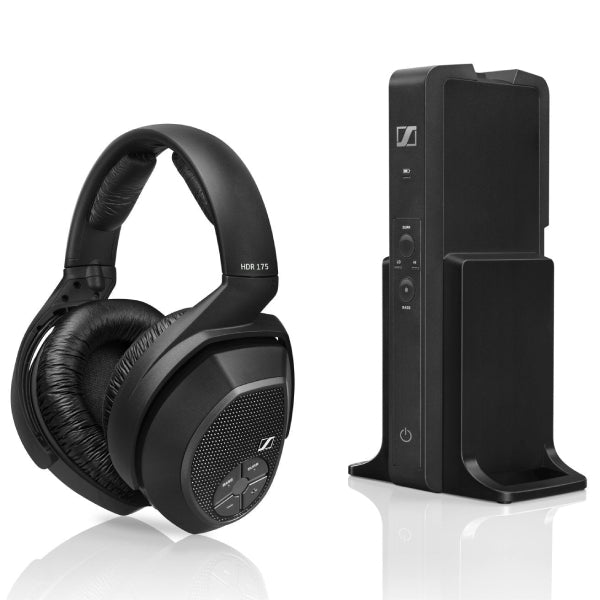
Specs
- Type: RF (radio-frequency) wireless over-ear TV headphone system
- Battery life: Up to 18 hours of use per charge
- Key features: Customizable listening modes, left/right balance control, RF wireless base that connects to TV, over-ear closed-back design
What we like
- High-quality sound optimized for TV and speech
- Customizable listening experience with multiple sound profiles
- Up to 18 hours of battery life for long viewing sessions
- RF connection avoids Bluetooth lag and pairing hassles
- Left/right balance control to compensate for asymmetric hearing loss
What we don’t
- Pricey compared with simpler RF systems
- Bulky for very small or sensitive heads
- Overkill if hearing loss is only mild
Performance and comfort
The Sennheiser RS 195 is one of the few TV headphone systems that feels purpose-built for hearing loss rather than just entertainment. The RF base connects directly to your TV and beams audio wirelessly to the headphones, avoiding the lip-sync issues that can plague Bluetooth-only setups. In testing and expert reviews, the RS 195 consistently stands out for its ability to clarify dialogue without turning everything else into a harsh, fatiguing wall of sound.
Unlike standard headphones, the RS 195 includes specialized listening modes and left/right balance adjustment. That means you can tweak the profile to emphasize speech frequencies and even compensate if one ear is weaker than the other—an extremely common pattern in older adults. These adjustments are easy to make once, then leave alone, which is ideal for seniors who don’t want to fiddle with settings every night.
Comfort is another strong point: the over-ear pads are well-cushioned and the clamping force is moderate, so most users can wear them through an entire movie or several episodes in a row. Battery life is excellent at up to 18 hours, and the RF base doubles as a dock, so the system is always charged when it’s returned to its stand.
Bottom line: For families where hearing loss is a significant factor—and you want the most tailored, “hearing-aid-style” TV sound experience—the Sennheiser RS 195 is our top pick. It’s expensive, but the combination of customization, clarity, and ease of use makes it a standout for serious TV and movie watchers.
Purchase links: See the standard RS 195 on Sennheiser or major retailers.
Insignia NS-HAWHP2 Wireless Home Theater Headphones ($140) – Best Budget RF TV Headphones

Specs
- Type: RF wireless over-ear TV headphones with charging dock
- Battery life: ~11–12 hours in testing
- Key features: RF transmitter/charging base, analog and (typically) digital inputs, low-latency transmission
What we like
- Excellent comfort for marathon TV sessions
- Very low audio lag (~17 ms reported in testing)
- Clean, balanced sound that outperformed pricier competitors in some tests
- Docking station simplifies both charging and connection
- Battery life exceeding 11 hours in independent tests
What we don’t
- Only supports a single pair of headphones—no add-on headsets
- No advanced EQ or hearing profiles
- Slightly compressed sound compared with higher-end systems
- Dock takes up some shelf space
Performance and comfort
Insignia’s NS-HAWHP2 is a Wirecutter-style workhorse: not flashy, but very comfortable and impressively well-tuned for the price. Multiple testers have noted that the sound is consistently balanced and pleasant, with no obvious hiss or harshness, and that the system has less lag than much of the competition—making it ideal for binge-watching TV and fast-paced gaming without lip-sync issues.
From a senior-care perspective, what stands out most is usability. The RF base connects to the TV and doubles as a charger: you lift the headphones to watch, drop them back on the stand to charge. There’s no fiddling with tiny USB jacks or remembering to plug anything in. Once set up, many households can go months without changing a thing.
Comfort is also a highlight. The headset is lighter than many competitors and is designed not to fatigue the ears over long sessions. Testers reported easily getting through full seasons of TV on a weekend without hot spots or pressure points around the ears.
The main drawback is flexibility: you can’t add another headset for a partner, and there aren’t built-in hearing-specific tools like left/right balance or speech-boost profiles. But if you just need a reliable, comfortable, affordable RF TV headphone for one listener, it’s a great fit.
Bottom line: Budget doesn’t have to mean compromised. For under $150, the NS-HAWHP2 offers surprisingly strong comfort, low latency, and good sound, making it our favorite entry-level RF system for older adults.
Purchase links: See the NS-HAWHP2 at Best Buy and other major retailers.
Sennheiser Set 860 Digital TV Listening System (~$300) – Best Lightweight TV Listening System for Seniors

Specs
- Type: Under-chin stethoscope-style TV listening system (assistive listening device)
- Battery life: Up to 18 hours
- Key features: Speech clarity function, multiple hearing profiles, individual left/right volume control, auto on/off, up to ~70 m (200 ft) wireless range
What we like
- Dedicated Speech Clarity button that boosts vocal frequencies
- Simple, intuitive controls with large, clearly marked buttons
- Lightweight under-chin design that doesn’t interfere with glasses or hearing aids
- Individual volume control for each ear
- Long battery life and automatic on/off to avoid accidental drain
What we don’t
- In-ear design isn’t ideal for people who dislike earbuds
- Less immersive for big movie soundtracks than over-ear systems
- Typically more expensive than basic RF headphones
Performance and comfort
While over-ear RF systems dominate the “TV headphones” category, many older adults find them heavy, hot, or awkward with glasses and hearing aids. The Sennheiser Set 860 takes a different approach: a very lightweight under-chin stethoscope headset that sits in the ear canal and hangs gently under the jaw. This design is common in clinics and theaters because it’s easy to put on and doesn’t conflict with eyewear.
What makes the Set 860 particularly attractive for hearing loss is its focus on speech intelligibility. A dedicated Speech Clarity function boosts the frequencies where consonants live—those “s,” “t,” and “f” sounds that often disappear first with age-related hearing loss. There are multiple hearing profiles that let you tailor how aggressively the system emphasizes speech versus overall sound, and you can independently adjust the volume in each ear.
From a usability standpoint, the Set 860 shines: the volume control is large and easy to feel, the on/off behavior is mostly automatic, and setup is designed to be straightforward even for less tech-savvy users. If you’re supporting an older parent who might be intimidated by modern gadgets, this simplicity goes a long way.
Bottom line: For seniors who prioritize clear dialogue, lightweight comfort, and simple controls over “home theater” immersion, the Sennheiser Set 860 is an excellent, hearing-focused alternative to bulkier over-ear headphones.
Purchase links: See the Set 860 on Sennheiser and specialist hearing retailers.
Avantree Quartet Wireless Headphone System – Best for Families & Group Watching

Image caption: Avantree Quartet base station with several headsets arranged on a coffee table, ready for family movie night.
Specs
- Type: RF-style multi-listener wireless headphone system
- Battery life: Up to ~20 hours per headset
- Key features: Transmitter supports up to 100 headsets, multiple EQ modes, analog and digital audio inputs, USB-C charging splitter
What we like
- One transmitter can broadcast to up to 100 compatible headphones
- Easy to set up with both analog and digital TV outputs
- Long battery life (around 20 hours) is ideal for heavy TV users
- Includes multiple EQ profiles to tune sound to preference
- Replaceable earpads extend the system’s life and comfort
What we don’t
- Sound quality is only “pleasant,” not class-leading
- Bass lacks definition compared with the Insignia system
- Earcups don’t swivel, which can make fit awkward for some users
- Expensive if you need to buy many individual headsets
Performance and comfort
The Avantree Quartet is built for scenarios where multiple people want personal TV audio—think couples with different volume preferences, extended families, or small group homes. The transmitter can broadcast to a surprisingly large number of headsets (up to 100), so you can start with the included pairs and add more over time as needed.
Sound quality is described as “acceptably pleasant rather than exceptional,” and in testing it hasn’t quite matched the Insignia NS-HAWHP2 for clarity and balance. But for many group-watching situations, that’s an acceptable trade-off for flexibility: everyone gets a stable wireless signal, personal volume control, and no risk of the TV blasting the rest of the house.
Battery life, at around 20 hours, is a real asset for older adults who don’t want to think about charging daily. The included USB-C charging splitter simplifies things further, letting you charge multiple headsets from one outlet.
Bottom line: If your main problem isn’t just “Grandma can’t hear the TV” but “everyone wants different volumes,” the Avantree Quartet is a clever way to keep the peace. It’s not the last word in audiophile performance, but it’s hard to beat for shared listening flexibility.
Purchase links: See the Avantree Quartet on Avantree and major retailers.
Avantree Oasis Plus 2 Bluetooth Transmitter – Best If You Already Own Headphones or Wear Bluetooth Hearing Aids

Image caption: Avantree Oasis Plus 2 transmitter connected to a TV, with a pair of wireless headphones nearby.
Specs
- Type: Bluetooth transmitter (and receiver) for TV audio
- Battery life: N/A (plugs into power)
- Key features: Multiple connection options (optical, AUX, etc.), low-latency Bluetooth when paired with compatible headphones, can transmit to multiple devices simultaneously
What we like
- Flexible: works with Bluetooth headphones, earbuds, and some Bluetooth-enabled hearing aids
- Good sound quality and low latency with compatible devices
- Multiple input/output options for newer and older TVs
- Strong customer support reputation
What we don’t
- Bluetooth pairing can be confusing for some older adults (“blind pairing”)
- Performance depends heavily on the headphones you pair with it
- Can struggle in very “noisy” wireless environments
- No USB wall adapter included in some packages
Performance and comfort
The Avantree Oasis Plus 2 is technically not a headphone—it’s the bridge that turns any compatible Bluetooth headphone or earbud into a TV-listening setup. That makes it ideal if you already own comfortable, familiar headphones or if you wear Bluetooth hearing aids that can receive audio directly. Instead of buying a dedicated RF system, you plug the Oasis Plus 2 into your TV and let it handle the wireless legwork.
Reviews highlight strong sound quality and low latency when the transmitter is paired with headphones that support the right Bluetooth codecs. That’s a key caveat: if you pair it with cheap, high-lag Bluetooth earbuds, you’ll still see lip-sync issues. But used correctly, it can be a powerful way to upgrade an existing setup without replacing hardware your loved one already likes.
From a caregiving perspective, the main challenge is pairing and re-pairing devices. The Oasis Plus 2 offers a lot of flexibility, but that also means more chances for confusion. In homes where someone tech-comfortable can set it up and occasionally troubleshoot, it’s fantastic; in environments where that’s not possible, an RF kit may be less stressful.
Bottom line: If your household already owns good Bluetooth headphones—or if you’d like to stream TV directly to Bluetooth-enabled hearing aids—the Avantree Oasis Plus 2 is the most flexible pick here, and a smart way to modernize your TV audio without starting from scratch.
Purchase links: See the Oasis Plus 2 on Avantree and major retailers.
Buying Advice – How to Choose TV Headphones for Hearing Loss
Why TV Dialogue Is So Hard to Hear
Before you pick a product, it helps to understand the problem you’re solving. For many older adults, the issue isn’t just “the TV isn’t loud enough”—it’s that speech becomes muddy and hard to distinguish from music and effects. Age-related hearing loss often hits the high-frequency range first, where consonants live, so voices can sound muffled even at high volumes.
At the same time, modern TV mixes are more complex than ever. Big, cinematic soundtracks and dense effects are layered under dialogue, while flat-screen TV speakers are often pointed at the wall or down at a cabinet, further muddying speech. For viewers with hearing loss, this combination can make even simple shows exhausting to follow.
TV headphones and listening systems tackle this in two ways:
- Direct, close-up sound that bypasses bad TV speakers and room acoustics.
- Processing tools such as speech-boost modes, EQ profiles, and balance control that enhance the parts of the signal most important for understanding voices.
RF vs. Bluetooth vs. TV Listening Systems
RF (Radio-Frequency) TV Headphones
- Use a dedicated transmitter and receiver pair (like the RS 175, RS 195, and Insignia NS-HAWHP2).
- Pros: Very low latency, stable long-range signal, simple “turn on and go” operation.
- Cons: Typically locked to a specific headset; not as flexible across multiple devices.
Bluetooth Headphones + Transmitters
- Use a Bluetooth transmitter (like Avantree Oasis Plus 2) to send TV audio to one or more Bluetooth devices.
- Pros: Extremely flexible; can use your favorite headphones or some Bluetooth-enabled hearing aids; easy to move between devices.
- Cons: Latency varies; some combinations cause noticeable lip-sync delay; pairing can confuse less tech-savvy users.
Dedicated TV Listening Systems (Under-Chin / Stethoscope Style)
- Use lightweight in-ear receivers with a neck/under-chin band (e.g., Sennheiser Set 860).
- Pros: Very light; easy to put on and remove; often include strong speech-clarity tools and per-ear volume control; friendly for glasses wearers.
- Cons: Less immersive sound; may be uncomfortable for those who dislike in-ear designs.
In most cases:
- Choose RF if you want minimal lag and a dedicated “TV only” solution.
- Choose Bluetooth + transmitter if you have or want multi-purpose headphones or hearing aids.
- Choose a TV listening system like the Set 860 if ease of use, speech clarity, and lightweight comfort are more important than cinematic sound.
Key Features That Matter for Seniors and Caregivers
From our review of buying guides, user reports, and expert testing, a few features consistently make the biggest difference for older adults and those with hearing loss:
- Speech-Focused Sound Controls
- Look for “speech,” “dialogue,” or “speech intelligibility” modes that emphasize vocal frequencies.
- Adjustable treble/bass or multiple hearing profiles are useful for fine-tuning.
- Amplification & Volume Headroom
- Ensure the system has enough maximum volume to comfortably overcome hearing loss without distortion.
- Some models specifically market themselves as “amplified TV headphones” for hearing-impaired users.
- Left/Right Balance Control
- Essential if one ear hears significantly better than the other.
- Found on more hearing-focused systems like the Sennheiser RS 195 and Set 860.
- Comfort & Weight
- Lightweight designs and soft ear cushions are crucial for long viewing sessions, especially for those with arthritis or neck issues.
- Over-ear models suit users who tolerate bulk; under-chin or in-ear designs may be easier for frailer seniors.
- Battery Life & Charging Ease
- Aim for at least 10–15 hours of battery life to avoid daily charging.
- Docking bases (Insignia, Sennheiser RF systems) eliminate tiny connectors and are easier for shaky hands.
- Simplicity of Controls
- Large, clearly labeled buttons and straightforward power behavior matter more than flashy features.
- Avoid systems that require constant re-pairing, navigating small screens, or complicated app control for elderly users.
- Compatibility with Your TV
- Check what outputs your TV has (optical, HDMI ARC, headphone jack, RCA) and ensure the system supports them.
- Newer TVs may disable internal speakers when something is plugged into the headphone jack—important if others still rely on TV speakers.
Price & Value: What to Expect
From the products and guides we reviewed, TV listening systems generally fall into three bands:
- Budget (under ~$150):
- Typically simpler RF systems like the Insignia NS-HAWHP2.
- Best for single users who just need clear, reliable TV sound and don’t mind basic looks and limited customization.
- Midrange (~$150–$300):
- Includes multi-listener systems like Avantree Quartet and many Bluetooth transmitter kits.
- Good balance of comfort, flexibility, and features.
- Premium ($300+):
- Includes hearing-focused systems such as Sennheiser RS 195 and Set 860.
- Offer advanced speech clarity tools, user-friendly ergonomics, and better long-term build quality—worth it if TV is a central daily activity.
For elderly care, it’s usually smarter to invest slightly more in comfort and ease of use than in audiophile-grade sound or exotic features. A system that actually gets used every night is far more valuable than a “perfect” one that’s too confusing to operate.
Safety and Hearing Health Tips
A quick but important note: needing higher TV volume than others can be an early warning sign of hearing loss. If someone constantly reaches for the remote while others complain, it may be time for a hearing test, not just a new gadget.
A few practical guidelines:
- Keep volume at the lowest comfortable level. TV headphones make it easy to crank the sound; encourage users to start low and increase only as needed.
- Watch for signs of listening fatigue or tinnitus (ringing in the ears) after long sessions—these may indicate over-amplification.
- Combine headphones with subtitles when possible. Closed captions can reduce the need for extreme volume boosts and reduce strain.
- Schedule regular check-ups with an audiologist. A good hearing professional can adjust hearing aids, suggest TV-streaming accessories, and make sure your chosen solution is safe and effective long-term.
Final Thoughts
For many families, TV isn’t just background noise—it’s shared time, comfort, and connection. When hearing loss turns every show into a guessing game, that simple pleasure can disappear fast. The good news is that modern TV headphones and listening systems offer real, practical relief: clearer dialogue for the person who needs it, and quieter living rooms for everyone else.
If you’re shopping for yourself and want a truly tailored listening experience, the Sennheiser RS 195 and Set 860 stand out for their focus on speech clarity and user-friendly controls. If you’re a caregiver looking for something simple and affordable that “just works,” the Insignia NS-HAWHP2 is a strong starting point. For larger households, Avantree’s Quartet and Oasis Plus 2 add the flexibility to support multiple listeners or reuse headphones and hearing aids you already own.
Ultimately, the “best” TV headphones are the ones that match the person: their hearing profile, their tech comfort level, and how they like to watch. Start with clarity and comfort, keep setup as simple as possible, and don’t hesitate to loop in a hearing-care professional if TV is just one piece of a bigger hearing-health puzzle.
Source List
BestPickReviews – “Best 5 TV Headphones for Seniors in 2025 – Crystal Clear Audio Without Disturbing Others” – https://www.bestpickreviews.co.uk/pick/best-5-tv-headphones-for-seniors-in-2025-crystal-clear-audio-without-disturbing-others/
TechRadar – “Best Headphones for TV Watching” – https://www.techradar.com/best/headphones-for-tv-watching
Soundly – “Best TV Headphones for the Hearing Impaired” – https://www.soundly.com/blog/best-tv-headphones-hearing-impaired
Simolio – “Best Wireless Headphones for TV for Hearing Impaired” – https://www.simolio.com/en-gb/blogs/category/best-wireless-headphones-for-tv-for-hearing-impaired
Reddit r/audio – “Headphones for Hearing Loss on TV” – https://www.reddit.com/r/audio/comments/14tt0q5/headphones_for_hearing_loss_on_tv/
Reddit r/audio – “Headphones to Amplify TV Sound for Hearing” – https://www.reddit.com/r/audio/comments/1e1rbx8/headphones_to_amplify_tv_sound_for_hearing/
Reddit r/HeadphoneAdvice – “Headphones for TV Viewing for Elderly Parents” – https://www.reddit.com/r/HeadphoneAdvice/comments/1gkfvg1/headphones_for_tv_viewing_for_elderly_parents/
NYTimes Wirecutter – “Best Wireless Home Theater Headphones” – https://www.nytimes.com/wirecutter/reviews/best-wireless-home-theater-headphones/
NYTimes Wirecutter – Insignia NS-HAWHP2 section – https://www.nytimes.com/wirecutter/reviews/best-wireless-home-theater-headphones/#if-you-only-need-one-set-of-headphones-insignia-ns-hawhp2
Amazon – Avantree Oasis Plus 2 Bluetooth Transmitter product page – https://www.amazon.com/Avantree-Bluetooth-Transmitter-Receiver-Simultaneously/dp/B0DHCKM5T4/
Amazon – Insignia NS-HAWHP2 RF Wireless Over-Ear Headphones – https://www.amazon.com/Insignia-NS-HAWHP2-Over-Ear-Headphones/dp/B07N8H8RKC
TV Ears – “The Best Wireless Headphones for TV (2025 Guide)” – https://www.tvears.com/uncategorized/wireless-headset-for-tv/
Sennheiser – Set 860 Digital Wireless TV Listening System manual – https://assets.sennheiser.com/global-downloads/file/9316/Set_860_Manual_1118_EN.pdf
Diatec Diagnostics – Sennheiser Set 860 product page – https://diatec-diagnostics.ca/en/sennheiser-set-860-digital-wireless-tv-listening-2
HearWorldUSA – Sennheiser Set 860 overview – https://www.hearworldusa.com/assistive-listening-systems/tv-listening-systems/sennheiser-set-860-digital-wireless-tv-listening-system/
Hearing Aid UK / Hearing Link Services – “I Keep Turning Up the Volume on the TV” – https://www.hearingaid.org.uk/hearing-loss-awareness/i-keep-turning-up-the-volume-on-the-tv
Cleveland Clinic – “Hearing Loss: Types, Symptoms, Causes & Treatment” – https://my.clevelandclinic.org/health/diseases/17673-hearing-loss
NHS Inform – “Hearing Loss” – https://www.nhsinform.scot/illnesses-and-conditions/ears-nose-and-throat/hearing-loss/
NYU Langone – “Five Early Signs of Hearing Loss You Shouldn’t Ignore” – https://nyulangone.org/news/five-early-signs-hearing-loss-you-shouldnt-ignore
Audiologists.org – “The Signs of Hearing Loss, According to an Audiologist” – https://audiologists.org/resources/symptoms/signs-of-hearing-loss
HearingYourBest.com – “10 Signs of Hearing Loss You Shouldn’t Ignore” – https://www.hearingyourbest.com/blog/10-signs-of-hearing-loss-you-shouldnt-ignore/
Southern Indiana ENT – “9 Signs You Should Visit an Audiologist About Hearing Loss” – https://www.southernindianaent.com/9-signs-you-should-visit-an-audiologist-about-hearing-loss/
ZVOX – “Why Can’t I Hear Dialogue on TV Anymore?” – https://zvox.com/blogs/news/why-can-t-i-hear-dialogue-on-tv-anymore
Home Cine Solutions – “Practical Guide to Improving Your TV Audio and Saying Goodbye to Hard-to-Hear Dialogue” – https://en.homecinesolutions.fr/blog/posts/1416-practical-guide-to-improving-your-tv-audio-and-saying-goodbye-to-hard-to-hear-dialogue
Sonos – “How to Hear Dialogue Better When Watching TV & Films” – https://www.sonos.com/en/blog/how-to-hear-dialogue-better


